
Assess children’s speech sound production at sentence level with this Informal Speech Sound Assessment for SLPs and SLTs.
Children may produce speech sounds accurately in single words but demonstrate errors when using those same sounds in longer sentences. This printable speech sound assessment provides a structured way to examine articulation and speech sound production in sentences, helping clinicians identify errors and patterns that may not be apparent during single-word assessment.
With 33 stimulus sentences, a recording and scoring form, and two presentation formats, this resource is designed for use by qualified Speech-Language Pathologists (SLPs) and Speech and Language Therapists (SLTs) during informal assessment and ongoing therapy.
What’s Included?
33 Speech Sound Assessment Sentences
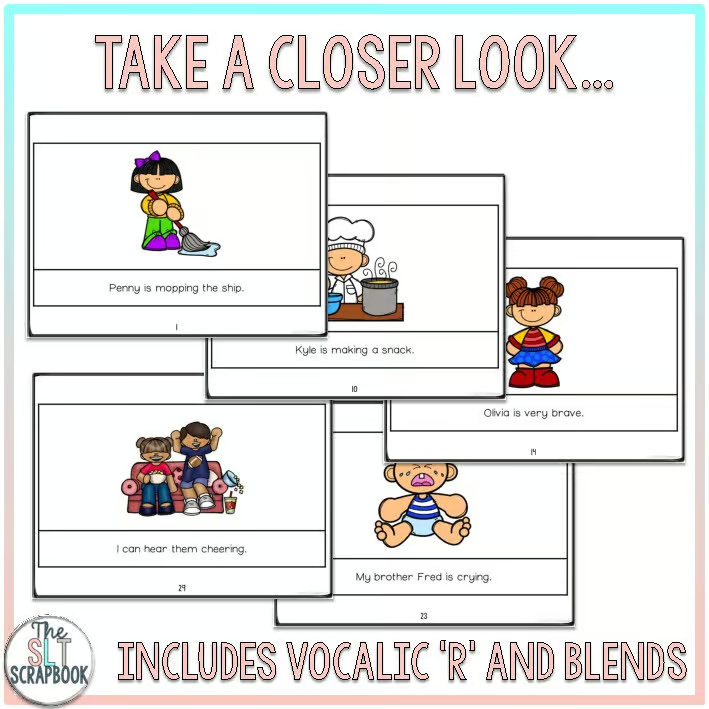
This resource contains 33 stimulus sentences targeting individual speech sounds, consonant blends and vocalic /r/.
Each sentence is designed to elicit a particular speech sound in different word positions, where possible.
Examples include:
- /p/: “Penny is mopping the ship.”
- /h/: “Hayley has a birdhouse.”
- /d/: “Todd the dog is in a puddle.”
- /tʃ/ (CH): “Charlie took a picture of the beach.”
The sentences provide opportunities to observe speech sound production within longer utterances rather than isolated words.
Consonant Blend Assessment
The resource includes sentences targeting:
- /s/ blends
- /l/ blends
- /r/ blends
These sentences contain a mixture of blends in word-initial position only.
Vocalic /R/ Assessment
Six sentences are included for assessing different vocalic /r/ patterns:
- ER
- EAR
- AR
- OR
- IR
- AIR
Each vocalic /r/ sentence targets the relevant sound in medial and final word positions.
Recording and Scoring Form
A recording form is included to help clinicians document children’s responses and identify speech sound errors.
The form features:
- Target sentences listed in presentation order
- Colour-coded target words for easy identification
- Space for phonetic transcription
- Flexibility to record individual target words or complete sentences
- A notation system for identifying modelled responses
Clinicians can use the form to document speech sound substitutions, omissions, distortions and other observed error patterns.
Please note: This is an informal assessment resource and does not provide standardised scores or normative data.
How to Use This Informal Speech Sound Assessment
- Present the stimulus sentences to the child, one page at a time.
- Read each sentence slowly and clearly, encouraging the child to repeat it.
- Alternatively, ask children who can read to produce the sentences independently.
- Listen carefully to the child’s production of the target speech sounds.
- Record responses on the included scoring form.
- Use phonetic transcription to document errors and identify patterns requiring further investigation.
If the child repeats a sentence following an adult model, indicate this on the recording form using the circled M notation.
This allows you to distinguish modelled responses from independently read sentences when reviewing the results.
Two Presentation Formats Included
Choose the format that best suits your assessment setting.
Full-Page Version
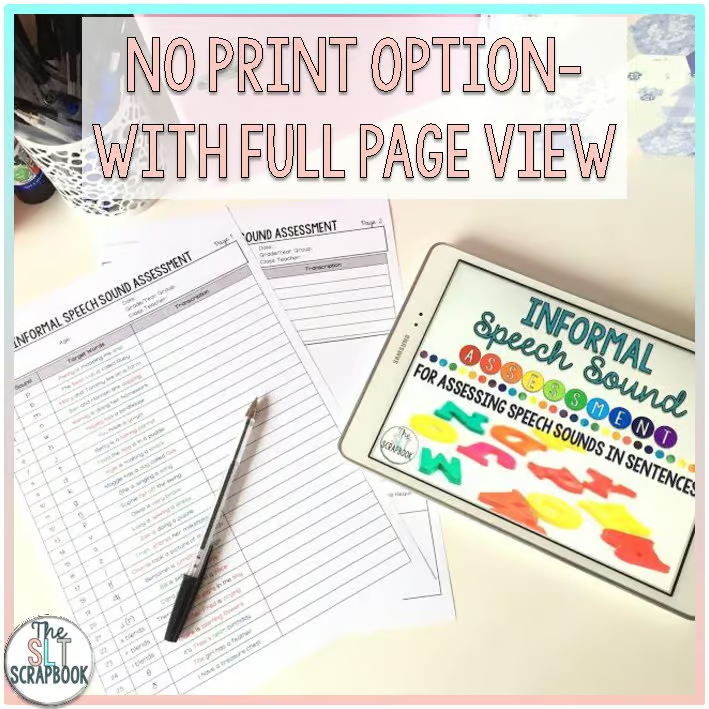
The full-page format can be displayed digitally on a tablet or other suitable device.
This allows you to present the stimulus sentences electronically while printing only the recording form.
Half-Page Version
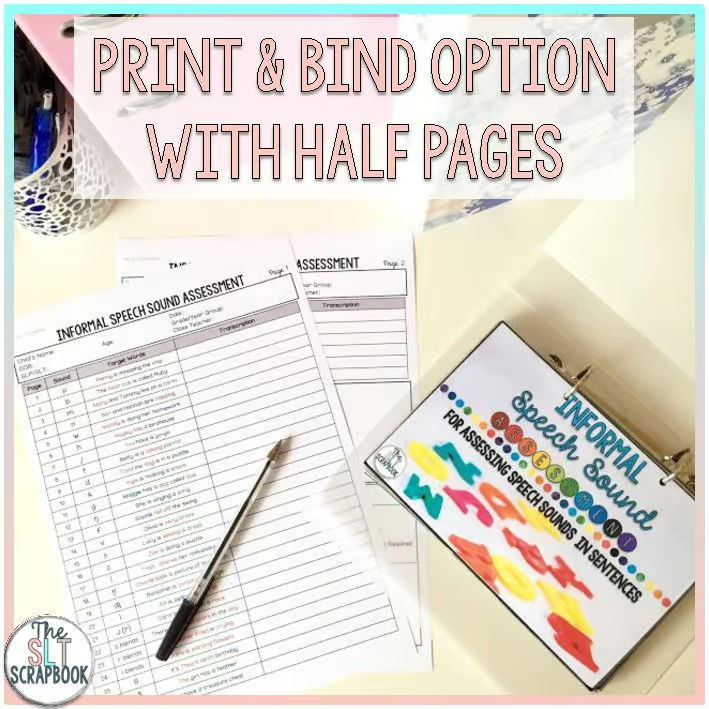
The half-page format is designed for printing.
Pages can be:
- Printed and cut in half
- Laminated for durability
- Organised in a small binder for repeated use
Both options provide flexibility for clinicians working in different therapy environments.
Who Is This Resource Suitable For?
The sentences may be particularly appropriate for elementary or primary school-aged children, approximately Kindergarten to Grade 5.
However, suitability should always be determined by the assessing clinician, taking into account the child’s age, language abilities, attention, reading skills and individual needs.
The resource may be useful when:
- A child produces target sounds accurately in single words but makes errors in sentences
- Monitoring speech sound production beyond word level
- Identifying errors in different word positions
- Examining consonant blend production
- Assessing vocalic /r/ within sentences
- Informing individualised speech sound therapy targets
- Monitoring changes in speech sound production during intervention
Why Assess Speech Sounds in Sentences?
Single-word assessments provide valuable information about children’s speech sound production. However, performance in isolated words does not always reflect how accurately those sounds are produced in longer utterances.
Sentence-level assessment introduces additional linguistic demands, including transitions between words and increased utterance length.
This informal assessment provides a structured opportunity to observe speech sound production under these conditions.
It can be used alongside other assessment methods to build a more complete picture of a child’s speech sound skills.
Looking for a Single-Word Speech Sound Assessment?
You may also be interested in our Informal Speech Sound Assessment – Single Words, which focuses on assessing speech sounds at word level.
Using word-level and sentence-level assessment materials can help clinicians explore differences in speech sound production across contexts.
Important Clinical Disclaimer
This resource is intended for informal assessment and therapy monitoring by qualified Speech-Language Pathologists (SLPs) and Speech and Language Therapists (SLTs).
It is not a standardised assessment and does not provide normative data, standard scores, diagnostic cut-offs or validated measures of speech sound ability.
Results should be interpreted using professional clinical judgement and considered alongside relevant case history, speech samples, formal assessments where appropriate, and other clinical information.
This resource should not be used as the sole basis for diagnosis, eligibility decisions, service provision, educational placement or other significant clinical decisions. Where formal or standardised assessment is required for clinical reports, educational planning or eligibility determinations, clinicians should use appropriate validated assessment procedures in accordance with applicable professional and local requirements.
The SLT Scrapbook does not accept responsibility for clinical decisions made solely on the basis of this informal resource.
This is a digital download. No physical product will be shipped.


Reviews
There are no reviews yet.