Early Intervention Speech Therapy
Understanding how Early Intervention supports communication through everyday interactions, play, and routines
Early Intervention Speech Therapy focuses on supporting young children (typically aged 0-3, or 0-5 years) who show delays in speech, language, or communication development.
Keep reading to learn more about Early Intervention Speech Therapy, as well as useful resources and related topics.

What is Early Intervention?
Early Intervention Speech Therapy focuses on supporting young children (typically aged 0-3, or 0-5 years) who show difficulties in one or more areas of speech, language, or communication development.
The goal of Early Intervention is to build these communication skills during everyday routines and play, when children learn best. Rather than relying only on structured activities, therapists often use play-based therapy and routine-based intervention to help children practise communication in natural, meaningful contexts.
A key component of Early Intervention is caregiver-coaching, where therapists partner with parents and caregivers to model strategies and skills they can use throughout the day. This approach helps create more opportunities for communication and carryover of skills between sessions, supporting steady progress during the critical early years of development.
In some areas, Early Intervention is a team-based approach, where Speech-Language Pathologists, Occupational Therapists, etc. work together to support the family in all aspects of their child’s development. Learn more about this approach to Early Intervention on the ASHA website here.
Benefits of Early Intervention Speech Therapy
Research shows that early intervention, especially when caregivers are supported to use strategies within everyday interactions, can improve children’s communication outcomes (Ref: Roberts and Kaiser, 2011).
Early Intervention is also associated with broader developmental benefits. Strong early language skills are linked to later success in areas such as learning, social interaction, and emotional development, highlighting the importance of supporting communication as early as possible. (Ref: Early Intervention Foundation).
A key factor in effective Early Intervention is the role of caregivers. Approaches that support caregivers to use strategies within daily routines and play create more frequent and meaningful opportunities for communication. This consistent exposure to language throughout the day is what drives steady progress over time, rather than relying solely on isolated therapy sessions. (Ref: Roberts and Kaiser, 2015).
What Does Early Intervention Look Like in Practice?
Recommended best-practice in Early Intervention is to use a caregiver coaching approach. Learn more about caregiver coaching in Early Intervention Speech Therapy here.
Caregiver coaching involves the therapist coaching the parent or caregiver to use skills and strategies to support their child’s development at home. The therapist and parent/caregiver are equal partners in these sessions.
This approach often looks very different from more direct, traditional Speech Therapy approaches where the therapist works 1:1 with the child, and there is little parent/caregiver involvement.
Early Intervention Speech Therapy sessions are family-centred and often indivdualised for each family. When using the coaching approach in Early Intervention, rather than focusing on formal tasks or isolated targets, support is embedded within play, everyday interactions, and familiar routines. The adult is coached to use language facilitation strategies and other skills to support the child’s communication skills.
In practice, this might involve simple activities such as playing with toys, reading books, or engaging in everyday routines like snack time or getting ready to go out. These situations provide repeated, meaningful opportunities for children to hear and use language in context.
A key part of this approach in Early Intervention is carryover. Caregivers are encouraged to identify times when they will use these new skills and strategies with their child at home between visits.
Although we know that caregiver coaching is an effective, evidence-based approach to use in Early Intervention, it is not the only approach to use. Direct therapy can be beneficial for some young children and in some circumstances. Each child and family is unique. It is important that you use your professional judgment, and liaise with caregivers to discuss their family’s needs, goals, and expectations, and use the most appropriate approach that meets their needs.
Who is Early Intervention Speech Therapy For?
Early intervention speech therapy is designed for babies, toddlers and young children who need support with their speech, language or communication development. A child does not necessarily need a formal diagnosis to benefit from early intervention. Support may be appropriate whenever there are concerns about how a child is communicating, understanding language or interacting with others.
Children receiving early intervention speech therapy may need support with areas such as:
- Understanding language, including following directions and learning new words.
- Expressing themselves, from early gestures and sounds through to words and sentences.
- Social communication and interaction, such as taking turns, sharing attention and communicating with other people.
- Developing early communication skills, including imitation, gestures, play and intentional communication.
- Speech development, when difficulties producing or learning speech sounds affect communication.
- Using augmentative and alternative communication (AAC), where additional ways of communicating can help a child express themselves.
Early intervention can support children with a wide range of developmental profiles. This includes children with identified communication needs or developmental conditions, as well as children whose families or professionals have concerns about their communication development but who do not have a diagnosis.
Importantly, early intervention is not simply about providing therapy directly to a child. Parents and caregivers are often central to the process. Speech and language therapists can help caregivers identify opportunities to support communication during play, everyday routines and interactions, allowing children to practise and develop their skills throughout their day.
Our Early Language Units are a great example of Early Intervention activities that can be delivered in 1:1 sessions, while also encouraging caregiver involvement.

What Skills Can Early Intervention Support?
Early intervention speech therapy can support a wide range of skills involved in a child’s speech, language and communication development. The specific areas targeted will depend on the individual child, their strengths and needs, and the priorities of their family.
Early intervention may support skills such as:
- Receptive language — understanding words, phrases, questions and directions.
- Expressive language — communicating wants, needs, ideas and experiences using gestures, sounds, words or sentences.
- Early communication — developing skills such as intentional communication, imitation, gestures and shared attention.
- Vocabulary development — learning and using new words across everyday activities and routines.
- Social communication — interacting with others, taking turns, initiating communication and participating in shared activities.
- Play skills — developing communication and language through exploratory, functional and pretend play.
- Speech sound development — supporting children who have difficulty learning or producing the sounds needed for spoken communication.
- Augmentative and alternative communication (AAC) — supporting communication through methods such as signs, symbols, communication boards or speech-generating devices alongside or instead of spoken language.
These skills do not develop in isolation. For example, a child might practise understanding language, taking turns and using new words during the same play activity. Early intervention therefore often focuses on creating meaningful opportunities for communication within everyday interactions, rather than teaching individual skills only during structured therapy activities.
Get the EI Starter Kit
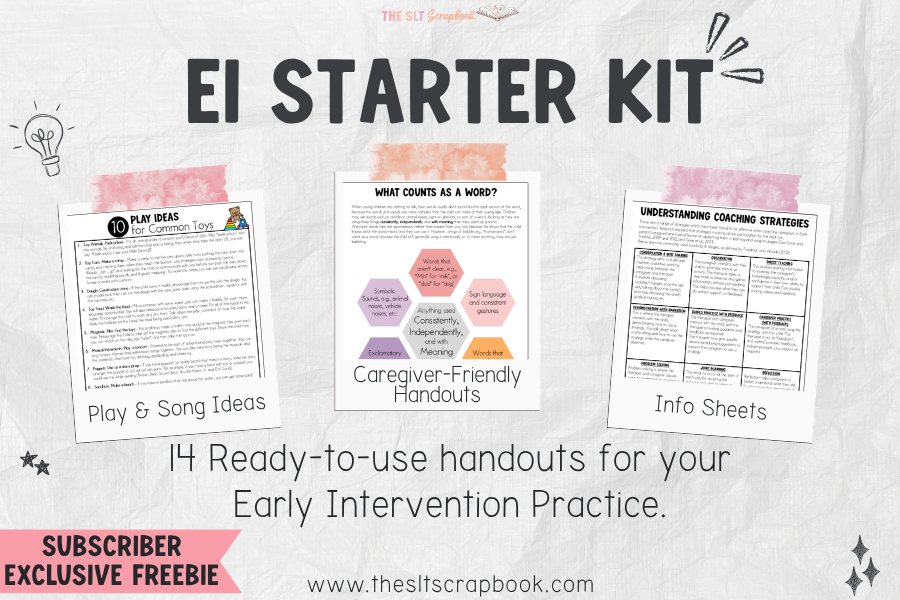
The EI Starter Kit is a mini-guide to help you start delivering effective and engaging Early Intervention sessions. It includes information sheets for therapists (such as the Coaching Strategies and Language Strategies pages), as well as caregiver-friendly handouts you can use in your EI sessions.
The handouts and resources included in this EI Starter Kit have been adapted from some of our best-selling resources, to give you a taster of what we offer here at The SLT Scrapbook.
Explore Related Topics
Ready to feel confident in your Early Intervention sessions?
Join my email list for weekly tips and ideas for Early Intervention, plus get access to my EI Starter Kit full of materials to support your practice.
You’ll get practical strategies you can use in your sessions, evidence-based approaches explained clearly, and resources that make your job easier – not harder.