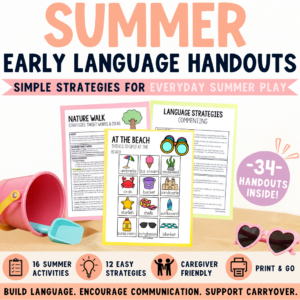
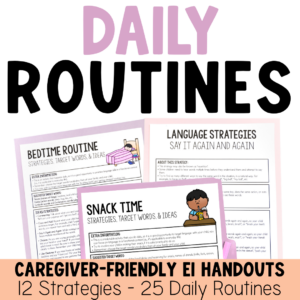
Support communication development with strategies designed for use in everyday interactions, play, and routines.
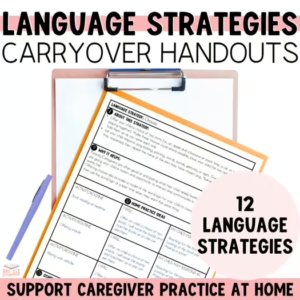
Support communication development with early language strategies designed for use in everyday interactions, play, and routines. These evidence-based approaches help children build foundational communication skills while supporting caregiver understanding and involvement.
Whether you’re working with late talkers or delivering early intervention sessions, these strategies provide a clear, practical framework for building language in meaningful contexts.
Early language strategies are practical techniques used to support communication development during everyday interactions. Rather than relying on structured tasks, these approaches focus on building language through play, routines, and shared experiences.
Using language strategies helps children experience language in meaningful contexts, making it easier to understand and use communication skills over time.
Common Language Strategies
There are a range of language strategies that can be used to support communication development.
These include:
Modelling and expanding language
Following the child’s lead
Commenting instead of questioning
Using gestures and visual supports
Creating communication opportunities
Repetition and verbal routines
These strategies are often most effective when used together, allowing you to adapt your approach based on the child’s needs and level of development.
Why Early Language Strategies Work
These strategies are effective because they are used within natural interactions, rather than isolated tasks. This helps children learn language in contexts that are meaningful and relevant to them.
They also support caregiver involvement, which is a key factor in successful early intervention. When caregivers understand and use strategies consistently, children are exposed to more frequent and varied language input throughout the day.
This leads to stronger carryover of skills and more opportunities for communication development beyond therapy sessions.
References:
Buschmann et al., 2009, and colleagues, cited by Finestack and Fay, 2013, in Rescorla and Dale, 2013
Ready to feel confident in your Early Intervention sessions?
Join my email list for weekly tips and ideas for Early Intervention, plus get access to my EI Starter Kit full of materials to support your practice.
You’ll get practical strategies you can use in your sessions, evidence-based approaches explained clearly, and resources that make your job easier – not harder.
We use cookies on our website to give you the most relevant experience by remembering your preferences and repeat visits. By clicking “Accept”, you consent to the use of ALL the cookies.
This website uses cookies to improve your experience while you navigate through the website. Out of these, the cookies that are categorized as necessary are stored on your browser as they are essential for the working of basic functionalities of the website. We also use third-party cookies that help us analyze and understand how you use this website. These cookies will be stored in your browser only with your consent. You also have the option to opt-out of these cookies. But opting out of some of these cookies may affect your browsing experience.
Necessary cookies are absolutely essential for the website to function properly. These cookies ensure basic functionalities and security features of the website, anonymously.
Cookie
Duration
Description
cookielawinfo-checbox-analytics
11 months
This cookie is set by GDPR Cookie Consent plugin. The cookie is used to store the user consent for the cookies in the category "Analytics".
cookielawinfo-checbox-functional
11 months
The cookie is set by GDPR cookie consent to record the user consent for the cookies in the category "Functional".
cookielawinfo-checbox-others
11 months
This cookie is set by GDPR Cookie Consent plugin. The cookie is used to store the user consent for the cookies in the category "Other.
cookielawinfo-checkbox-necessary
11 months
This cookie is set by GDPR Cookie Consent plugin. The cookies is used to store the user consent for the cookies in the category "Necessary".
cookielawinfo-checkbox-performance
11 months
This cookie is set by GDPR Cookie Consent plugin. The cookie is used to store the user consent for the cookies in the category "Performance".
viewed_cookie_policy
11 months
The cookie is set by the GDPR Cookie Consent plugin and is used to store whether or not user has consented to the use of cookies. It does not store any personal data.
Functional cookies help to perform certain functionalities like sharing the content of the website on social media platforms, collect feedbacks, and other third-party features.
Performance cookies are used to understand and analyze the key performance indexes of the website which helps in delivering a better user experience for the visitors.
Analytical cookies are used to understand how visitors interact with the website. These cookies help provide information on metrics the number of visitors, bounce rate, traffic source, etc.
Advertisement cookies are used to provide visitors with relevant ads and marketing campaigns. These cookies track visitors across websites and collect information to provide customized ads.