An evidence-based approach for Early Intervention Speech Therapy
Caregiver coaching is a well-established evidence-based approach that therapists use in Early Intervention Speech Therapy sessions with parents and caregivers.
Keep reading to learn more about caregiver coaching in Early Intervention, as well as useful resources and related topics.
Caregiver coaching in Early Intervention is an approach where the therapist works with the parent/caregiver to help them learn and develop knowledge and skills that support their child’s development in a variety of areas.
In the coaching approach, the therapist and caregiver are collaborative partners. The caregiver is encouraged to be directly involved in supporting their child, identifying strategies they want to work on, and reflecting on what works. The therapist facilitates the adult’s learning through the use of Adult Learning Methods and specific coaching strategies.
The aim of the caregiver coaching approach in Early Intervention is on increasing the caregiver’s confidence and competence in their skills, so they can support their child’s development across various settings and routines between sessions.
Why is Caregiver Coaching Important?
As Early Intervention therapists, we know that children spend more time at home with their parents and caregivers than they do in therapy with us. This means that there is a lot of time when children could be exposed to opportunities for learning that would potentially be missed if you’re not using a coaching approach.
By using a coaching approach, we can support parents and caregivers to identify opportunities for communication and to use skills and strategies that help develop their child’s skills between Speech Therapy sessions.
Benefits of Caregiver Coaching in Early Intervention:
Coaching parents/caregivers to use strategies and techniques to support language and communication skills is associated with improved outcomes for children and increased use of supportive strategies by caregivers (Ref: Roberts et al., 2019).
Coaching caregivers to integrate strategies and skills into their everyday routines naturally increases the dose and intensity of input/services a child receives (Ref: Romano et al., 2022).
What does Caregiver Coaching Look Like in Practice?
There are a range of approaches you can use when delivering caregiver coaching sessions (for example, the Early Childhood Coaching Model by Rush and Shelden, the TMCR Approach by Roberts and Kaiser, 2014, or the SSOOPPRR approach by FGRBI). All of these approaches follow a similar set-up and all involve the use of Adult Learning Methods and coaching strategies to support adult learning.
In practice, a typical caregiver coaching session in Early Intervention may follow this structure:
Starting the session with information sharing- getting updates and discussing progress.
Then, leading into the session by talking about what they did between sessions, and encouraging the caregiver to demonstrate this with the child. This is an opportunity for observation.
You may focus on introducing a new skill or strategy, and this is often done via direct teaching and demonstration.
A key part of effective caregiver coaching is caregiver practice. Encouraging the caregiver to practise a new skill or strategy in the session with the child. The therapist can then provide feedback and guidance as needed, to support accurate implementation.
Throughout the session, there are opportunities for problem solving and reflection. It is important that caregivers are encouraged to take the lead during these discussions, to support their learning and understanding of strategies.
Sessions should always end with a joint plan. This is where the therapist and caregiver discuss and decide what the caregiver will practise with the child between sessions, as well as what they plan to do at the next visit. This plan then becomes the starting point in your next caregiver coaching sessions.
Want to Feel Confident Delivering Caregiver Coaching Sessions?
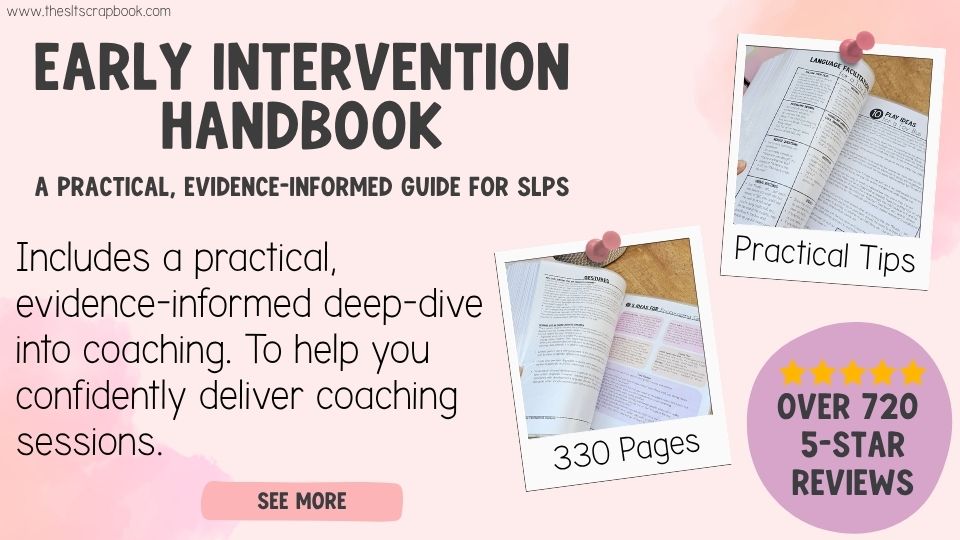
The Early Intervention Handbook is your complete guide to confident, evidence-based caregiver coaching in your Early Intervention Speech Therapy sessions.
Now expanded to 330 pages, this comprehensive, evidence-informed handbook is designed to help you feel confident, prepared, and supported in every Early Intervention Speech Therapy session you deliver.
It includes a deep dive into coaching strategies and approaches, with practical tips and ideas to help you feel confident delivering caregiver coaching sessions.
⭐⭐⭐⭐⭐ A must-have for EI SLPs - This is honestly like a bible for Early Intervention/caregiver coaching! It is PACKED with information, from research summaries, to milestones, strategies, handouts, examples based on different activities, etc etc. I refer back to it constantly. Thank you for creating such a wonderful resource!
⭐⭐⭐⭐⭐ My GO-TO resource for every EI child! - I LOVE this resource and it's really helped parents see how they can bridge what I'm doing in therapy with their child to daily routines and within their natural environment! I've recommended this to everyone I can!
⭐⭐⭐⭐⭐ A well-crafted resource - I LOVE this handbook. I am relatively new to EI (doing it per diem in addition to my FT job). This handbook provides coaching examples as well as activities with toys and daily routines I can implement and show to parents.
Ready to feel confident in your Early Intervention sessions?
Join my email list for weekly tips and ideas for Early Intervention, plus get access to my EI Starter Kit full of materials to support your practice.
You’ll get practical strategies you can use in your sessions, evidence-based approaches explained clearly, and resources that make your job easier – not harder.
We use cookies on our website to give you the most relevant experience by remembering your preferences and repeat visits. By clicking “Accept”, you consent to the use of ALL the cookies.
This website uses cookies to improve your experience while you navigate through the website. Out of these, the cookies that are categorized as necessary are stored on your browser as they are essential for the working of basic functionalities of the website. We also use third-party cookies that help us analyze and understand how you use this website. These cookies will be stored in your browser only with your consent. You also have the option to opt-out of these cookies. But opting out of some of these cookies may affect your browsing experience.
Necessary cookies are absolutely essential for the website to function properly. These cookies ensure basic functionalities and security features of the website, anonymously.
Cookie
Duration
Description
cookielawinfo-checbox-analytics
11 months
This cookie is set by GDPR Cookie Consent plugin. The cookie is used to store the user consent for the cookies in the category "Analytics".
cookielawinfo-checbox-functional
11 months
The cookie is set by GDPR cookie consent to record the user consent for the cookies in the category "Functional".
cookielawinfo-checbox-others
11 months
This cookie is set by GDPR Cookie Consent plugin. The cookie is used to store the user consent for the cookies in the category "Other.
cookielawinfo-checkbox-necessary
11 months
This cookie is set by GDPR Cookie Consent plugin. The cookies is used to store the user consent for the cookies in the category "Necessary".
cookielawinfo-checkbox-performance
11 months
This cookie is set by GDPR Cookie Consent plugin. The cookie is used to store the user consent for the cookies in the category "Performance".
viewed_cookie_policy
11 months
The cookie is set by the GDPR Cookie Consent plugin and is used to store whether or not user has consented to the use of cookies. It does not store any personal data.
Functional cookies help to perform certain functionalities like sharing the content of the website on social media platforms, collect feedbacks, and other third-party features.
Performance cookies are used to understand and analyze the key performance indexes of the website which helps in delivering a better user experience for the visitors.
Analytical cookies are used to understand how visitors interact with the website. These cookies help provide information on metrics the number of visitors, bounce rate, traffic source, etc.
Advertisement cookies are used to provide visitors with relevant ads and marketing campaigns. These cookies track visitors across websites and collect information to provide customized ads.