
Understanding Emotions Activities & Worksheets – Full of Feelings
Help children explore, recognise, describe and communicate their feelings with Full of Feelings – Understanding Emotions Activities and Worksheets!
This comprehensive printable resource includes over 100 usable pages, featuring emotions posters, flashcards, games, worksheets, scenario cards, visual supports and more.
Designed for Speech and Language Therapy, classrooms and individual or small-group intervention, these activities provide opportunities to develop emotional vocabulary, emotional literacy, expressive language and understanding of feelings.
With a mixture of structured worksheets, interactive games and discussion-based activities, you can select materials to suit different learning goals, ages and abilities.
⭐ Why Therapists Love These Understanding Emotions Activities
- Over 100 usable pages, including instruction pages
- Targets 12 common emotions and feelings
- Includes posters, flashcards, games and printable worksheets
- Supports emotional vocabulary and expressive language
- Encourages discussion about feelings and experiences
- Includes activities for exploring emotions in different situations
- Colour and black-and-white versions of many activities
- Selected worksheets available with and without visual supports
- Suitable for individual therapy and small groups
- Flexible materials that can be adapted to different communication needs
⭐ 12 Emotions and Feelings Covered
This resource explores the following emotions and feelings:
- Happy
- Sad
- Angry
- Worried
- Scared
- Surprised
- Excited
- Jealous
- Embarrassed
- Disappointed
- Confused
- Tired
The activities provide opportunities to introduce and revisit emotional vocabulary, discuss what different feelings mean, and explore how people may experience and communicate emotions.
Children can also be supported to describe their own feelings using speech, AAC, visuals or other appropriate communication methods.
⭐ What’s Included?
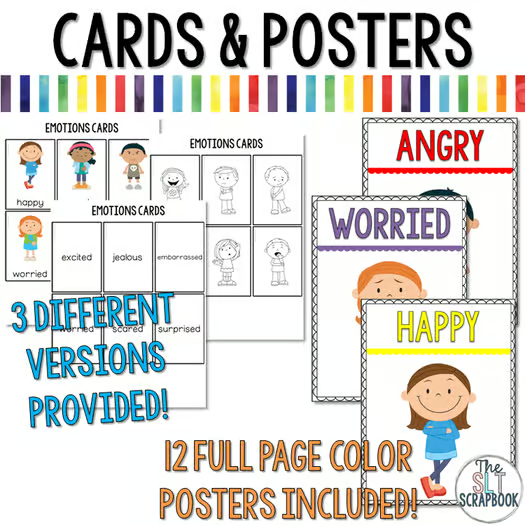
1. Emotions Flashcards
Printable emotion cards provided in various formats.
Use these to introduce vocabulary, practise naming feelings, support matching activities or prompt conversations about emotions.
2. Emotions Posters
Visual posters featuring the target emotions.
These can be displayed in therapy rooms, classrooms or other learning environments to provide ongoing access to emotional vocabulary.
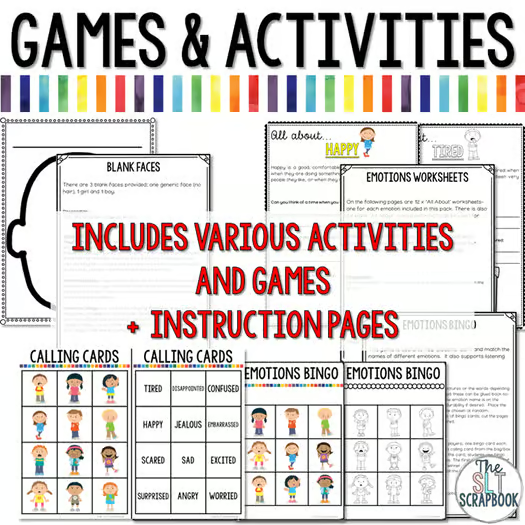
3. Blank Faces
Printable blank face templates for exploring different facial expressions.
Children can draw or create expressions, discuss what they notice, and explore different ways emotions might be communicated.
4. Emotions Bingo
An engaging game for revisiting emotions vocabulary through listening, recognition and matching.
Ideal for individual sessions and small groups.
5. “All About…” Worksheets
Structured worksheets for exploring individual emotions in greater detail.
These provide opportunities to discuss and describe feelings while developing emotional vocabulary.
6. “Describe the Feeling” Worksheets and Graphic Organisers
Visual organisers designed to help students describe emotions and develop their expressive language skills.
These activities can support vocabulary development, describing and discussion.
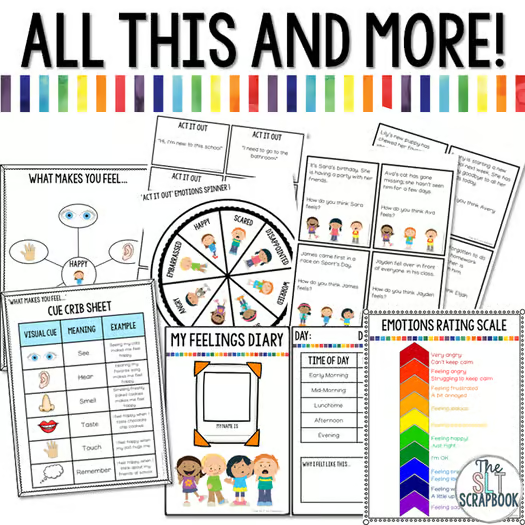
7. “What Makes You Feel…” Worksheets and Graphic Organisers
Activities that encourage children to explore situations and experiences associated with different feelings.
These can be used to support personal reflection and discussion, while recognising that different people may feel differently in the same situation.
8. “Act It Out” Cards and Emotions Spinners
Interactive materials for exploring emotions through games, discussion and optional role-play.
Students can use the prompts to practise emotion vocabulary, describe experiences or discuss how feelings might be expressed.
9. “How Are They Feeling?” Scenario Cards
Scenario-based activities designed to encourage children to consider how someone might feel in a particular situation.
Versions with and without visual supports are included.
These cards can be used to practise:
- Understanding emotion vocabulary
- Interpreting contextual information
- Making and explaining predictions
- Considering different emotional responses
- Expressive language and reasoning
- Discussing how people may experience situations differently
Encourage students to use clues from the scenario while recognising that there may be more than one reasonable emotional response.
10. Feelings Diary
A printable diary for recording and reflecting on feelings.
This can be used to support emotional vocabulary, personal expression and conversations about everyday experiences.
11. Emotions Rating Scale
Printable rating scales to help students communicate and discuss their feelings.
Versions with and without visual supports are included, allowing you to select the format most appropriate for the individual.
⭐ Language and Communication Skills Targeted
These Understanding Emotions Activities can support a range of Speech and Language Therapy goals.
Emotional Vocabulary
Introduce and revisit words for different feelings, helping students develop a broader vocabulary for describing emotions.
Expressive Language
Encourage children to describe feelings, explain their ideas, discuss experiences and formulate sentences.
Understanding and Interpreting Situations
Use the scenario cards to explore how different situations may be associated with different emotional responses.
Describing and Reasoning
Support students to describe relevant details, explain their thinking and consider alternative interpretations.
Communicating Personal Feelings
Provide structured opportunities for children to identify and communicate their own emotional experiences using their preferred communication methods.
⭐ Flexible Activities for Different Learners
Not every child will benefit from the same level of visual support or the same type of activity.
To help you adapt the resource, many worksheets and activities are available in both colour and black and white. Selected activities also include versions with and without visual supports.
You can choose activities according to individual language abilities, learning goals and preferences.
For example, you might:
- Introduce a small number of emotion words at a time
- Use visuals to support understanding
- Model vocabulary before asking students to use it
- Offer choices rather than relying on open-ended questions
- Explore fictional scenarios before discussing personal experiences
- Allow children to communicate through speech, AAC, pointing or other methods
- Use games to revisit previously introduced vocabulary
The activities are intended to support learning and discussion, rather than to test whether children display emotions in a particular way.
⭐ Perfect for:
- Speech and Language Therapists (SLTs)
- Speech-Language Pathologists (SLPs)
- Emotional vocabulary intervention
- Emotional literacy activities
- Receptive and expressive language therapy
- Social communication activities
- Primary and elementary classrooms
- Special education settings
- Individual Speech Therapy sessions
- Small-group language intervention
- Classroom discussions about feelings
⭐ Supporting Emotional Literacy Through Language
Understanding emotions involves more than recognising facial expressions.
Children may need support to develop vocabulary for their feelings, understand emotional language in different contexts, discuss experiences and communicate how they feel.
These activities provide a structured starting point for exploring emotional concepts through visuals, games, scenarios and conversation.
It’s important to recognise that emotions are personal experiences. People may express the same feeling in different ways, and facial expressions alone do not always tell us how someone feels.
When using the materials, encourage curiosity, flexible thinking and acceptance of different emotional experiences.
⭐ Explore More Speech and Language Therapy Resources
Looking for additional resources to support communication, vocabulary and language development?
Explore our Speech Therapy Resources Shop for printable activities, language worksheets and practical therapy materials.
For resources supporting younger children’s communication, you can also browse our Early Intervention Resources.
⭐ Additional Information
This resource was created by a qualified and certified paediatric Speech and Language Therapist based in the UK.
The information, strategies and activities included within this resource are based on current knowledge, evidence-informed practice and clinical experience at the time of writing. While every effort has been made to ensure the content is accurate and up to date, research and best practice recommendations continue to evolve over time.
This resource is intended to provide practical ideas and support for therapists, educators and caregivers. It is not intended to replace direct Speech and Language Therapy assessment, intervention, diagnosis or professional advice.
Practitioners should always use their professional judgement when selecting, adapting and implementing activities to meet the individual needs of the children they support. Not all activities will be suitable for every child or setting.
This resource may be reviewed and updated periodically to reflect new evidence, feedback and best practice recommendations.
Additional Product Information
- Digital download only
- Over 100 usable pages, including instructions
- Printable posters, flashcards, worksheets, games and activities
- Covers 12 emotions and feelings
- Colour and black-and-white versions of many activities
- Selected activities include versions with and without visual supports
- No physical product will be shipped
Support emotional vocabulary and communication with this comprehensive collection of Understanding Emotions Activities and Worksheets, designed to make exploring feelings engaging, accessible and meaningful.
Reviews
There are no reviews yet.