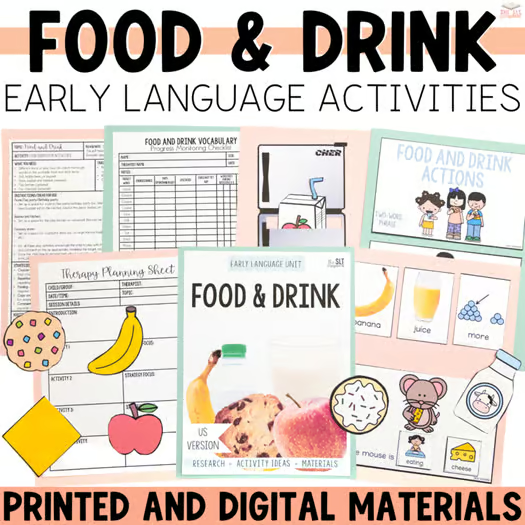
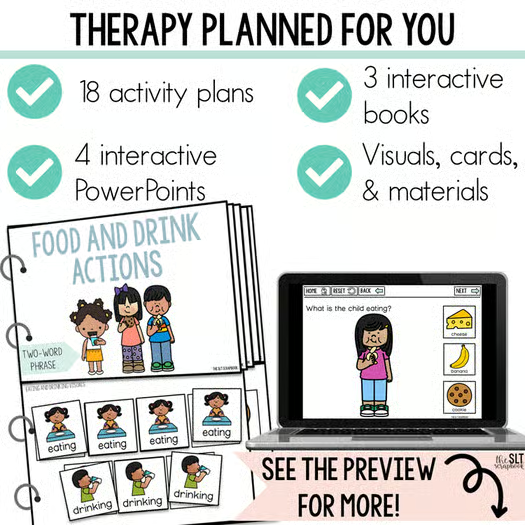
Support early vocabulary development with these Food and Drink Early Language Activities, designed for Speech-Language Pathologists (SLPs), Speech and Language Therapists (SLTs) and early intervention professionals working with toddlers and preschool children.
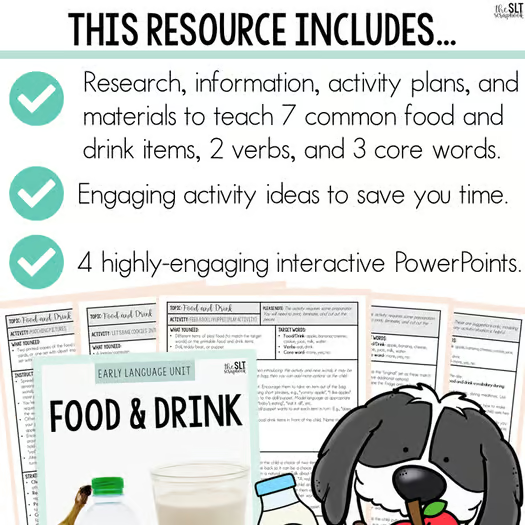
This comprehensive Food and Drink Early Language Unit provides a structured approach to teaching 12 carefully selected target words, including familiar food and drink vocabulary, action words and core words.
Based on the evidence-informed approach of focused stimulation, the unit combines adult-directed activities, child-led play, repeated language modelling and caregiver coaching to create meaningful opportunities for children to hear and use target vocabulary.
With printable activities, interactive PowerPoint games, therapy planning materials, vocabulary checklists and caregiver handouts, this resource provides practical support for early language intervention across therapy sessions and everyday routines.
Ideal for children developing their first words or those who would benefit from additional support with early vocabulary.
Target Vocabulary
This unit focuses on 12 early language targets organised into three categories.
Food and Drink Vocabulary – 7 Words
- Apple
- Banana
- Cheese
- Cookie
- Juice
- Milk
- Water
Action Words – 2 Words
- Eat
- Drink
Core Words – 3 Words
- More
- Yes
- No
The target words were selected with reference to published information about early vocabulary development and language acquisition.
Activities provide repeated opportunities for children to hear these words in meaningful contexts, with opportunities to encourage their use according to each child’s communication abilities.
What Is Focused Stimulation?
Focused stimulation is a language intervention approach in which adults provide frequent, meaningful models of selected target words or language structures during interactions with children.
Rather than requiring children to imitate every model, the approach emphasises repeated exposure to target language within engaging activities.
This Early Language Unit incorporates focused stimulation principles through:
- Repeated modelling of selected vocabulary
- Play-based language opportunities
- Structured adult-directed activities
- Child-led interactions
- Everyday routines and familiar experiences
- Caregiver involvement and home practice
The unit also includes research information and references to support clinicians in understanding the approach.
What’s Included?
Research and Therapy Planning Materials
The resource includes supporting information to help therapists plan and deliver early language intervention.
Included materials:
- Overview of the resource and intervention approach
- Research information and references
- Food and Drink vocabulary checklist
- Example therapy session plan
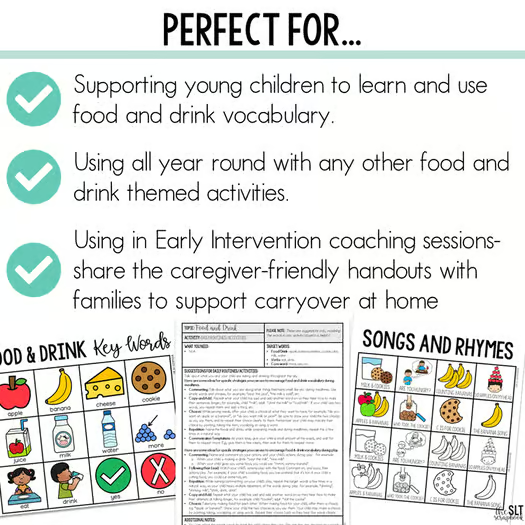
- Caregiver handout
- Blank therapy planning sheet
Vocabulary Checklist
Use the included Food and Drink vocabulary checklist to record children’s responses to the target words.
The checklist can support informal baseline information gathering and progress monitoring throughout intervention.
Therapist Activity Plans
The unit includes activity guidance to help clinicians incorporate the target vocabulary into structured tasks, play and everyday routines.
Plans provide examples of how to use language facilitation strategies and create opportunities for repeated language modelling.
Caregiver Handout
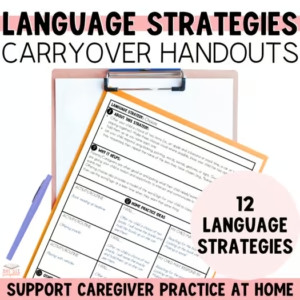
A caregiver handout is included to support the use of language strategies beyond therapy sessions.
This provides families with practical guidance for incorporating target vocabulary into familiar activities and daily routines.
Printable Early Language Activities
A variety of printable resources is included to help children become familiar with the target vocabulary.
Introducing the Vocabulary
Use the included vocabulary materials to introduce the 12 target words through pictures, real photographs and repeated language models.
Matching Activities
Includes picture-matching activities and Heads and Tails puzzles to provide opportunities for recognising and practising the target vocabulary.
Simple Games
Use familiar game formats to create repeated opportunities to hear and practise food and drink vocabulary.
Interactive Books
Incorporate the target words into shared reading and interactive language activities.
Dough Mats
Use the printable dough mats to combine hands-on play with language modelling.
Food and Drink Bingo
Practise recognising and using target vocabulary through printable Bingo activities.
Fill the Fridge
A printable activity providing opportunities to model food and drink vocabulary during a familiar everyday context.
Feed the Dog
Use this interactive printable activity to incorporate food vocabulary and action words into play.
Feed a Doll or Puppet
Encourage early language through pretend play involving feeding a doll or puppet.
Food-Themed Play Activities
Includes additional suggestions for incorporating target vocabulary into child-led play and familiar experiences.
Interactive PowerPoint Activities
The unit also includes four interactive PowerPoint activities for use during therapy sessions.
Activities included:
- Let’s Bake Cookies
- Matching Food and Drink
- Shopping List
- Eating and Drinking
These activities provide additional opportunities to model and practise the target vocabulary in an interactive format.
They can be used during in-person sessions or appropriate teletherapy activities.
Important compatibility information: The interactive activities are provided in PowerPoint Show format and require Microsoft PowerPoint. They are not compatible with Google Slides or Apple Keynote.
Additional Printable Materials
The resource includes a variety of materials to support the activities.
Vocabulary Cards
- Colour clipart cards with and without written words
- Black-and-white clipart cards with and without written words
- Real photograph cards with and without written words
- Additional cards for selected action and core words
Hands-On Activity Materials
- Food and Drink dough mats
- Phrase and sentence strips
- Food and Drink puzzles
- Printable Bingo materials
- Fill the Fridge activity materials
- Feed the Dog activity materials
- Additional food and drink picture sets
Selected activities and materials are provided in different formats, including colour, black-and-white, clipart and real photographs.
Songs, Books and Everyday Routines
The unit also includes suggestions for incorporating the target vocabulary into natural language-learning opportunities.
These include:
- Songs and rhymes
- Song and rhyme visuals
- Book suggestions
- Daily routines and activities
- Food-themed play experiences
These activities can help therapists and caregivers provide repeated language models across different contexts.
Who Is This Resource Suitable For?
These Food and Drink Early Language Activities are designed for professionals supporting young children who are developing early vocabulary.
They may be particularly useful for:
- Early Intervention SLPs and SLTs
- Speech therapists working with late-talking toddlers
- Preschool speech and language therapy
- Children developing single-word communication
- Children with gaps in their early vocabulary
- Caregiver coaching sessions
- Home-based speech therapy
- Play-based language intervention
- Individual and small-group therapy
The activities are primarily designed for children working at the single-word stage of expressive language development, although clinicians can adapt their use according to individual needs.
Supporting Early Language Through Everyday Activities
Food and drink are familiar parts of many children’s daily routines.
Mealtimes, snack preparation, pretend play and shopping activities can provide natural opportunities to model vocabulary and encourage communication.
This unit uses familiar food and drink concepts to help therapists introduce selected target words across different activities and contexts.
By combining structured activities with play and caregiver coaching, the resource provides opportunities for repeated language exposure within meaningful interactions.
Part of the Early Language Units Collection
This Food and Drink resource is also included in the Early Language Units Bundle, which contains six themed early language units.
Already own the bundle? Please check your existing resources before purchasing, as this Food and Drink unit is included in that collection.
Make Early Language Intervention Easier to Plan
With 12 target words, printable activities, interactive PowerPoint games, research information, therapy plans and caregiver materials, this Food and Drink Early Language Unit provides a practical framework for early vocabulary intervention.
Use the activities to introduce target words, create repeated opportunities for language modelling and support caregivers in incorporating language strategies into everyday routines.
Help children explore early language through familiar food and drink activities!
Important Information
This is a digital download. No physical product will be shipped.
The interactive digital activities require Microsoft PowerPoint and are not compatible with Google Slides or Apple Keynote.
This resource is intended for use by qualified speech and language professionals and other appropriately trained practitioners supporting early communication development.
Activities should be selected and adapted according to each child’s individual communication needs, developmental abilities and intervention goals.
The vocabulary checklist is intended for informal monitoring and is not a standardised language assessment.
Copyright © The SLT Scrapbook. All rights reserved.
This resource is licensed for use by the purchasing professional in their own educational or therapy setting. Caregiver handouts may be shared with the families they support in accordance with the resource’s Terms of Use.
Redistribution, resale or public sharing of the original resource files is not permitted.
Please refer to the full Terms of Use included with your download.
Reviews
There are no reviews yet.