Informal Language Assessment for Speech Therapy
Are you looking for an informal language assessment for speech therapy that you can use with late talkers and preschool-aged children with language delay?
This bundle contains two practical Early Language Informal Assessments designed to help Speech-Language Pathologists and Speech and Language Therapists assess receptive and expressive language skills, from single words through to short phrases.
With both structured and play-based assessment options, plus printable, digital editable and self-scoring assessment forms, you can choose the approach and recording method that best suits the child and your therapy sessions.
What’s Included in This Informal Language Assessment Bundle?
This money-saving bundle contains:
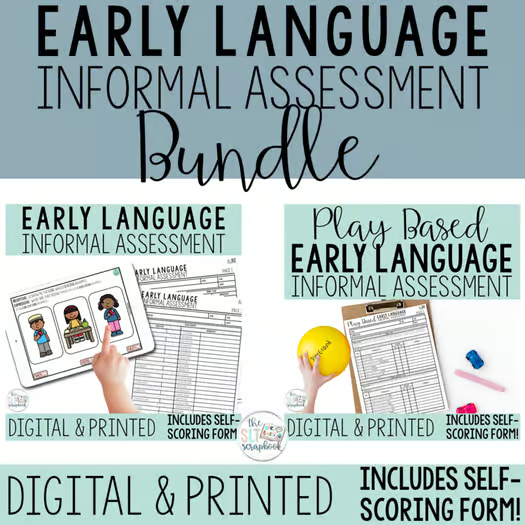
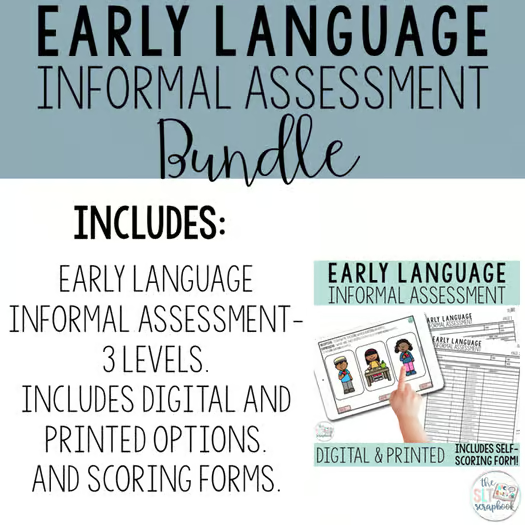
- The Early Language Informal Assessment, which includes digital and printable versions for use in both teletherapy and face-to-face sessions.
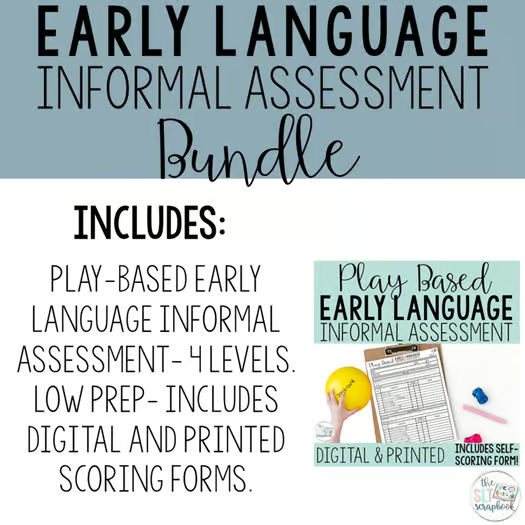
- The Play-Based Early Language Informal Assessment, which uses a play-based approach to assess early language skills and includes digital and printable assessment forms for use in teletherapy and face-to-face sessions.
- Save 15% compared with purchasing the two assessments separately.
What Do the Early Language Assessments Cover?
Quickly and easily assess receptive and expressive language skills from single words to short phrases using these informal early language assessments.
The assessments include three different data collection options, allowing you to choose the format that is most convenient for you:
- A printable version that can be printed and completed by hand.
- A digital editable version that can be opened in a PDF program such as Adobe Reader and completed on a computer. Drop-down boxes make it easy to score the receptive section. Please note: this version does not work on iPads.
- A self-scoring Excel document that can be completed on a computer. This version includes drop-down boxes for receptive and expressive items and automatically calculates scores, making it easier to record results and monitor progress over time.
Early Language Skills Assessed
Both informal assessments cover early language targets from one Key Word Level up to three or four Key Word Level (KWL).
Key Word Level is based on the number of Information Carrying Words* in an instruction — the minimum number of words a child needs to understand in order to comprehend an utterance.
It also relates to the target response the child would be expected to produce, such as a one-word, two-word or three-word utterance. Key Words and Information Carrying Words refer to the words within an utterance that carry meaning.
Receptive and expressive targets are included for most of the stimulus items. These include:
- 1 KWL: nouns (including animals, vehicles, clothing, food, furniture and body parts), verbs and prepositions (in, on, under and out of).
- 2 KWL: phrases consisting of two key words using semantic structures** including subject + verb (“agent + action”), verb + object (“action + object” and “action + locative”), possessor + possession, as well as prepositions (in, on, under, out of, off) and concepts/attributes.
- 3 KWL: phrases consisting of three key words, including subject + verb + object phrases (“agent + action + object” and “agent + action + locative”), alongside prepositions (in, under, on, out of, off).
The Play-Based Early Language Informal Assessment covers up to four key words.
Who Are These Informal Language Assessments For?
These resources have been designed for certified/licensed Speech-Language Pathologists and Speech and Language Therapists working with young children who require assessment of their early receptive and expressive language skills.
They may be particularly useful when working with late talkers, preschool-aged children and children with language delay, where an informal assessment can help provide an overview of a child’s current language abilities and support ongoing clinical decision-making.
These are informal, non-standardised assessments and are not intended to replace a formal language assessment or provide a diagnosis. Please see the full disclaimer below.
Supporting Early Language Development
Informal assessment can help identify a child’s current communication strengths and areas where additional support may be beneficial.
Learn more about supporting young children’s communication in our Early Intervention Speech Therapy guide and explore practical approaches in our Early Language Strategies guide.
References
Flahive, L.K., and Lanza, J.R. (2012). LinguiSystems Guide to Communication Milestones: 2012 Edition. LinguiSystems, Inc. Retrieved online, January 2020.
* The concept of Information Carrying Words is based on the work of Knowles and Masidlover (1982) and underpins the Derbyshire Language Scheme, a commonly used language programme in the UK and Ireland.
Knowles, W., & Masidlover, M. (1982). The Derbyshire Language Scheme. Derby: Derbyshire County Council, UK.
** The information regarding semantic structures is based on the work of Brown (1973), as cited in the ASHA Practice Portal:
ASHA Practice Portal – Semantic Relationships
Disclaimer
This is a digital download. No physical item will be sent.
- This informal assessment of early language skills is designed to be used by a certified/licensed Speech-Language Pathologist/Speech and Language Therapist.
- This informal assessment is intended to provide a general overview of a child’s language abilities. It has not been normed or standardised. Professional judgement should be used when interpreting results and making decisions regarding next steps.
- This informal assessment is not designed to replace a formal language assessment and should not be used to diagnose a speech and/or language delay or disorder, or to determine whether a child does or does not receive services. It is advised that a formal language assessment be administered where required for purposes such as reports, IEPs and IFSPs. The SLT Scrapbook, its owners and creators accept no responsibility for decisions related to the determination of eligibility and/or amount of services, or any other decisions made as a result of this assessment.
- Toys are required for the play-based assessment. Toys are not included with the download. This is a digital download only.
Reviews
There are no reviews yet.